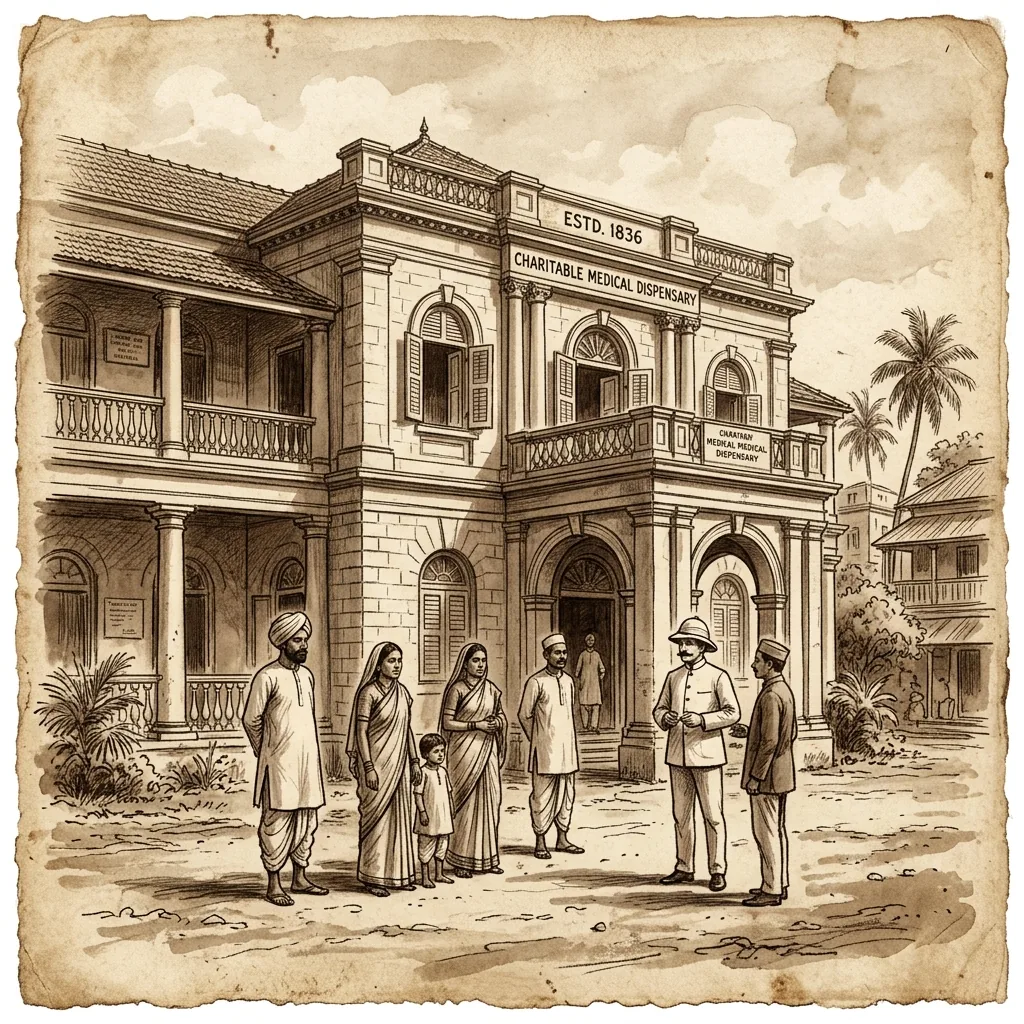
Bombay Native Dispensary (1836)
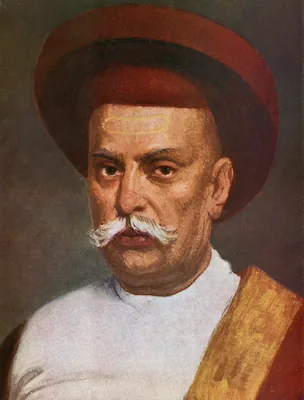
Jagannath “Nana” Shankarshet and the Making of Public Health in Bombay
When Bombay began growing into a crowded modern city, Nana Shankarshet understood that keeping its people healthy would require much more than hospitals.
He helped bring Western medical care to communities who had little access to it, supported charitable dispensaries for the poor, helped turn the idea of a memorial into a medical college that would train Indian doctors, and pushed for medical education that could reach students in their own language. He helped create a maternity institution designed around the privacy and customs of Indian women. And when public health became a question of water, drainage, sanitation, open space, or even where a community could cremate its dead, Nana was there again.
What makes this story remarkable is that these were not isolated acts of philanthropy. Nana was helping Bombay build the systems of a healthy city: places to treat the sick, institutions to train doctors, water to drink, streets and drains that could support a growing population, and public spaces where people could breathe and gather.
And many of those interventions left something behind that can still be found in Mumbai today.
The story that follows is not simply about the hospitals Nana helped build. It is about how he helped a 19th-century city begin to understand public health as a civic responsibility, and how much of that transformation is still visible around us.
1. Bombay Native Dispensary (1836)
In the 1830s, Bombay had a serious problem: illness was everywhere, but medical care was not.
European soldiers and officials had access to established medical facilities. For much of the native population, treatment still meant relying on traditional healers, astrologers and local apothecaries. Western medicine existed, but persuading people to trust it was another matter.
The idea of a medical institution for Bombay's native population began taking shape at a public meeting in 1834. The resulting Bombay Native Dispensary was established in a building provided rent-free by the government, with the formal committee taking shape in 1836.
Its founders understood that the first and most critical challenge was trust. Western medicine existed, but persuading people to use it was another matter.
The government provided the premises and funds for medicines. Indian philanthropists, including Nana Shankarshet, Sir Jamshetji Jeejeebhoy and Framji Cowasji, provided annual subscriptions. Doctors including William Mackie and Bremner offered their professional services.
A Pioneering Partnership:
It was an early public-private partnership in healthcare: government provided infrastructure and support, Indian philanthropists helped sustain it, and doctors provided treatment.
Nana's role went beyond writing a cheque. He was a founding subscriber and member of the managing committee, and the committee itself had an unusually modern objective: not merely to treat patients, but to popularize medical institutions and European remedies among a population that was understandably suspicious of them.
That helps explain why Nana's social position mattered. The dispensary needed people to believe that Western medicine was something they could safely use. Later biographies describe Nana personally encouraging families to overcome their fears and seek treatment. Contemporary records, more cautiously, identify him as a leading advocate for secular medical education in Marathi.
The experiment began to prove itself. On March 19, 1838, at a meeting of the dispensary's subscribers, Sir Jamshetji Jeejeebhoy proposed the creation of a full-scale hospital. The dispensary had demonstrated that Bombay's native population would use organized medical care, and that there was a much larger need to meet.
The idea eventually led to J.J. Hospital, and a few years later, in 1845, Grant Medical College followed, extending the city's medical infrastructure from treating patients to training doctors.
Nana's own philanthropy continued. In memory of his father, Shankarshet Babulshet, he established the Sunkersett Charitable Dispensary in Tardeo, providing free medical treatment to roughly 300 patients a day.
A Chain of Medical Progress: The Bombay Native Dispensary was not an isolated project; it was the beginning of a chain. A small clinic demonstrated the native population's willingness to use Western medicine, proving the need for a full-scale hospital (J.J. Hospital), which in turn expanded into professional medical training (Grant Medical College).
The important thing Nana helped establish was not simply a place to see a doctor. It was the idea that organized medical care should be accessible to Bombay's native population, and that earning their trust was part of the work.
2. Shankarshet Babulset Charitable Dispensary (1858)
By the 1850s, Bombay's medical system was growing, but it was not growing evenly. The Bombay Native Dispensary and the newly established J.J. Hospital provided medical care, but they were concentrated in the central city. For poor families living farther south, in places such as Tardeo, Mahalaxmi, Walkeshwar and Girgaum, getting treatment could still be difficult.
Nana Shankarshet responded by bringing medical care closer to them. In September 1858, he established the Shankarshet Babulset Charitable Dispensary in a Dharamshala near the Shri Bhavani Shankar Temple in Tardeo. The dispensary provided free diagnosis and medicines to poor patients every morning and evening.
The location was significant. The dispensary was not being placed in some distant institutional quarter of Bombay. It was being built into a neighbourhood where people actually lived.
A Self-Sustaining Legacy: Nana placed Rs. 24,000 (later adding Rs. 6,000) in government bonds to create a permanent Rs. 30,000 endowment. This ensured the clinic's operations would not depend on his lifetime, setting a precedent for institutional longevity.
There is also a revealing connection to Nana's earlier work. In 1838, at a public meeting held after the death of Governor Robert Grant, Nana had supported the idea of creating a medical institution as a memorial to Grant. That campaign eventually helped lead to Grant Medical College.
But Nana understood that a medical college and a charitable clinic served different purposes. One trained doctors. The other brought doctors and medicines to people who might otherwise have none. Twenty years after that earlier campaign, Nana was building the second kind of institution himself.
The dispensary became a healthcare lifeline for the working population of Tardeo and the surrounding neighbourhoods.
Transition to Nair Hospital:
After the First World War, rising costs meant that the income from the trust was no longer enough to run the dispensary independently. In 1921, the trustees changed the arrangement and transferred the Rs. 30,400 corpus to Bai Yamunabai L. Nair Hospital, where it was used to permanently endow a reserved hospital bed in the name of "Shankarshet Babulset."
The clinic disappeared; the endowment did not. Nana had not only built a place where a poor person could receive free medical care. He had built a financial structure designed to keep that promise alive, even when the original dispensary could no longer survive.
3. Sir Jamshetji Jeejibhoy Maternity Home (1850)
In the mid-19th century, childbirth in Bombay presented a problem that was difficult to solve with medicine alone. The city had doctors and a growing medical college, but there was nowhere suitable for women from the native community to receive obstetric care. Students at Grant Medical College were learning midwifery from books, yet they had little opportunity for clinical training because respectable women would not enter a general hospital ward to give birth.
A Place of Dignity for Women: On April 22, 1850, at the Asiatic Society meeting, Nana Shankarshet changed the argument. While doctors wanted a place to train, Nana made the case for something larger: a dedicated, private institution where poor women could receive proper assistance during childbirth, designed around their need for privacy and caste sensitivities.
His appeal produced immediate results. The meeting generated pledges of Rs. 12,000. Nana and Sir Jamshetji Jeejeebhoy each contributed Rs. 1,000, while Nana secured another Rs. 4,000 from the Gaikwad of Baroda.
Nana's role here was more than financial. As a member of the Board of Education and the committee developing the institution, he helped bridge two worlds: the medical professionals who needed a teaching facility and the Indian community that had to be persuaded to trust it. This mattered because childbirth was not simply a medical issue. Questions of privacy, caste and custom could determine whether women would actually use the institution.
The new institution therefore had to be designed around the women it hoped to serve. A committee was formed to establish its rules, and the project became known initially as the Obstetric Institution. Nana was part of that process, helping shape the institution rather than simply contributing money to it.
Sir Jamshetji Jeejeebhoy later made the project possible on a much larger scale. He provided a prime plot near Grant Medical College and increased his contribution to Rs. 15,000. In recognition of his substantial support, the institution eventually became known as the Sir Jamshetji Jeejeebhoy Maternity Home. It opened in 1852.
For Nana, the story had come full circle. The same medical system that needed patients for its students to learn from now had a dedicated institution where women could receive obstetric care in a setting designed for them. And the idea had begun with a public meeting, and a decision to speak about the problem not merely as a medical-school requirement, but as a question of whether poor women deserved proper care.
Today, the original maternity institution is connected to the medical complex at J.J. Hospital in Byculla, while the old Grant Medical College buildings and the Asiatic Society's Town Hall remain physical reminders of the medical and civic world in which Nana helped make the project possible.
4. Grant Medical College (1845)
When Bombay's Governor, Sir Robert Grant, died in 1838, the city began discussing how to honour him. Nana Shankarshet had a different idea. Instead of a statue or monument, he proposed something that would continue doing useful work after Grant was gone: a medical college.
The idea had a history behind it. In 1826, Governor Mountstuart Elphinstone had established a Native Medical School in Bombay, where Western medicine was taught in Marathi and Hindustani. But the school was abolished in 1832. Its graduates were trained only as subordinate medical assistants, with no path to the status of fully qualified physicians. Nana had seen that failure. When the opportunity came after Grant's death, he argued for something more ambitious: a college that could produce physicians and surgeons.
At the Town Hall meeting on July 28, 1838, Nana moved the proposal. He then helped lead the fundraising effort, raising Rs. 50,000 from the public, with the government matching the amount.
The memorial would not be made of stone. It would train doctors.
In 1845, the Grant Medical College opened with Dr. Charles Morehead as its first principal.
But creating the college was only the beginning. Its students now had to learn medicine in a society where some of the most important parts of Western medical education were deeply controversial. Human dissection was one of them. For orthodox Hindu and Parsi communities, handling a human corpse could violate powerful religious and social taboos. For a medical student, however, anatomy could not simply be learned from a textbook.
In 1846, the first three Hindu students, Bhau Daji Lad, Atmaram Pandurang and Ananta Chandroba, entered the dissection room. It was a small group, but a significant moment. Someone had to go first.
Nana's support mattered because the barrier was not simply academic. Young men entering the new profession needed their families and communities to accept what they were doing. Nana used his standing to encourage native students to enter the college and supported promising students through prizes and patronage. Among them was Bhau Daji Lad, who became one of the college's most distinguished graduates and a close associate of Nana.
The medical college also exposed another problem. Bombay could build an institution for training doctors, but those doctors needed somewhere to gain clinical experience. That need helped drive the development of the medical institutions around the college, including the hospital that became J.J. Hospital and the maternity institution established soon afterwards.
The college was never just a building where lectures were given; it was the beginning of a medical ecosystem.
There is another challenge Nana had not forgotten: language. The earlier Native Medical School had demonstrated that Western medicine could be taught in Indian languages. Years later, Nana again pushed for access to medical education for students who could not study comfortably in English. In 1861, he supported the introduction of a Marathi-medium medical curriculum and donated Rs. 5,000 towards scholarships for Marathi-speaking medical students.
The institution Nana had imagined in 1838 had therefore evolved in two directions: it trained doctors to practise modern medicine, and it found ways to make that education accessible to Indian students. The real memorial Nana had proposed was not a statue, but a profession.
5. Sonapur Cremation Ground Preservation
In colonial Bombay, even the way people said goodbye to their dead could become a political battle.
In the 1840s and 1850s, European health officials complained about Hindu cremations at Sonapur, near present-day Marine Lines. They argued that smoke and “effluvia” from the open-air pyres were carried by the sea breeze into nearby homes and posed a serious health risk. Dr. Andrew Leith, Bombay’s Health Officer, later made the case even more forcefully in his 1855 report on the sanitary condition of the island.
The Defensive Wall (1847):
Nana’s first response came not through a protest, but through a wall. In 1847, he raised ₹25,000 to build a high stone wall around the burning ground. It was an attempt to address the government’s concerns without forcing Hindus to abandon their cremation ground. The wall shielded the ceremonies from public view and removed one of the practical objections raised against Sonapur.
But the argument did not end there. More than a decade later, the government proposed legislation that could allow burial and burning grounds considered a public nuisance to be closed. The proposal threatened to move Hindu cremations away from the city, with bodies potentially having to be transported by railway to distant locations such as Worli or Sewri.
For Nana, this was no small change. Hindu funeral rites followed their own customs and rhythms. A railway timetable could move a body, but it could not simply replace the rituals surrounding death.
Nana was also in a position to challenge the proposal from inside government. As a member of the Bombay Legislative Council, he argued that the walled crematorium had already been considered safe by the Medical Board. If the wall had addressed the sanitary concerns, why was the government still trying to close the ground?
The Girgaum to Parel Protest (July 1864): When the legislative battle stalled, Nana took the argument to the streets. In July 1864, more than 2,000 citizens, including large numbers of local Kolis, marched from Girgaum to Governor Sir Bartle Frere's residence in Parel. This remarkable display of public resistance forced Frere to withdraw the proposal to close the cremation ground.
The victory preserved more than a cremation ground. It preserved a place that was part of the everyday geography of Bombay’s Hindu community. And the story did not disappear with the argument. The original Sonapur site is now associated with Chandanwadi Crematorium. The surrounding city has changed almost beyond recognition, but the cremation ground remains part of Mumbai’s landscape.
This was not simply a debate recorded in an old legislative proceeding. It was a struggle over a real place in the city, a place where Bombay’s people had performed one of their most important rituals, and where they continue to do so today. For Nana, modern Bombay could have railways, new roads and new systems of government. But progress did not mean that the city had to erase the customs of the people who lived in it.
6. Sanitation, Drainage, and Victoria Gardens (1857-1858)
By the middle of the 19th century, Bombay had a problem that was becoming impossible to ignore: the city was growing faster than its infrastructure. Inside the crowded Native Town, narrow streets, open drains and stagnant water made sanitation a constant concern. The massive walls around the Fort, once built for defence, had become a physical barrier to the movement of air and the expansion of the city.
Nana Shankarshet was one of the Indian voices arguing that the old walls had to go. He was among the Justices of the Peace who pressed the government on the issue during the 1850s, describing the walls as a nuisance to public health. In 1862, when Governor Bartle Frere established the committee that would formally oversee their removal, Nana was appointed as one of its few Indian members.
Removing the ramparts opened the way for Bombay to expand beyond the cramped Fort and helped create the wider city that would emerge around it. But Nana's approach to public health was not limited to walls.
When a severe drought struck Bombay in 1846, the city's public water sources began running dry. Nana responded by opening his own private family tank near his estate in Girgaon to people of all castes and communities.
Vihar Lake Water Project: Nana's response to the 1846 drought pointed towards a bigger idea: Bombay needed a reliable public water system, not just emergency relief. Serving on the Board of Conservancy, Nana championed the Vihar water project, which was inaugurated in 1856 and became the foundation of Bombay's modern piped water supply.
He was thinking about what happened after the water reached the city, too. In 1857, Nana championed a municipal measure requiring roads to be watered daily, and supported the move towards underground drainage to replace the foul open sewers that ran through the city.
But Nana did not see a healthier Bombay as simply a cleaner one. He also wanted the city to have places where people could breathe, walk and learn. That vision came together at Byculla.
The Agri-Horticultural Society of Western India, of which Nana was a life member and eventually President, worked to establish a permanent public garden. Nana helped secure the Mount Estate and led the effort to raise money for what became the Victoria Gardens and Albert Museum.
He personally contributed ₹4,000 to the project, and helped persuade Bombay's wealthy Indian merchants to contribute to a project initially associated with European-style gardens. Dr. Bhau Daji Lad, the Society's Secretary, worked alongside him. Nana handled much of the political and fundraising work; Bhau Daji Lad brought the scientific and curatorial side of the project to life.
Together, they helped turn the 33-acre Mount Estate into something more than a private collection of plants: it became a public garden.
Today, Victoria Gardens is Rani Baug, and the museum is the Dr. Bhau Daji Lad Museum. Vihar Lake still forms part of Mumbai's water infrastructure.
That is the interesting thread running through Nana's work on Bombay's public health: he was not solving isolated problems.
Water. Drainage. Roads. Open space. The removal of obsolete walls.
He was helping a crowded 19th-century city acquire the infrastructure it needed to become a modern one. And some of the places created through that effort are still part of Mumbai's landscape today.