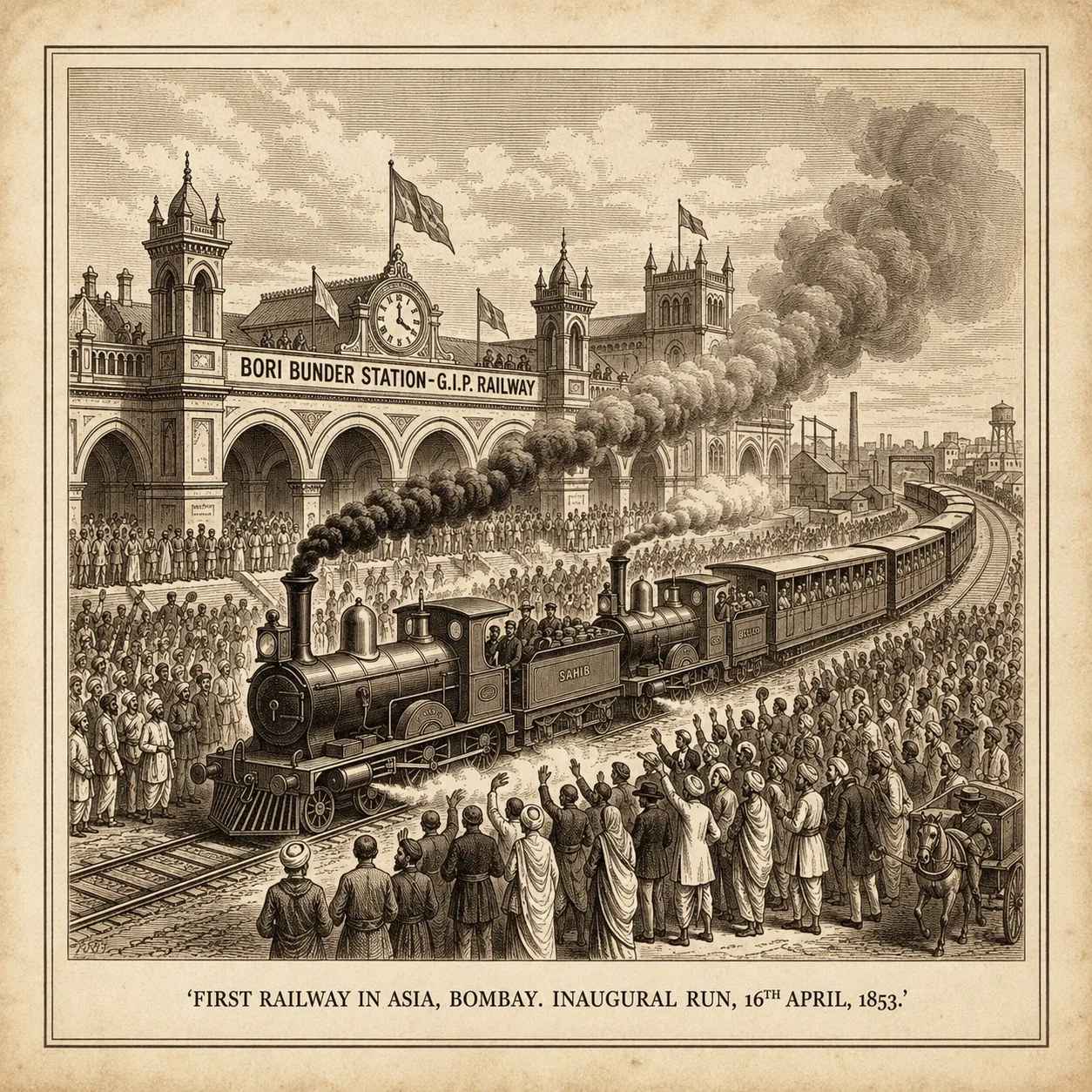
First Railway in Asia, Inaugural Run (16th April, 1853)
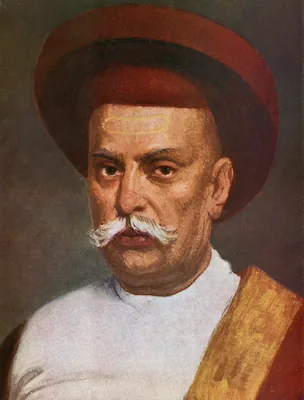
Jagannath “Nana” Shankarshet and the Making of Modern Transport in Bombay
Before Bombay could become a modern commercial city, it had to learn how to move.
People, goods, cotton, mail and capital all needed to travel faster and farther, but the technology alone was not enough. Someone had to persuade merchants to back a railway, negotiate with landowners, give engineers a place to work, convince a suspicious public that a steam locomotive was safe, and prove that Indian capital could compete in industries dominated by European companies.
Nana Shankarshet repeatedly found himself in the middle of those challenges.
He helped organise the movement that brought the railway to Bombay, became one of the early Indian directors and shareholders of the GIPR, housed its engineers in his Girgaon residence, and then climbed aboard the very first passenger train to Thane. He helped establish an Indian-majority steam navigation company, supported the infrastructure needed to handle Bombay's expanding trade, and helped turn waterfront land into space for the city's growing commercial economy.
What makes the story especially revealing is that Nana was not simply adopting new technology. He was helping Bombay absorb it. He connected British engineers with Indian landowners, modern finance with traditional commercial networks, and unfamiliar machines with a population that had to learn to trust them.
And there is perhaps no better symbol of that transformation than the one waiting at Mumbai's busiest railway terminus today: Nana's face, carved into the facade of CSMT more than two decades after his death, looking out over the railway that he had helped set in motion.
The story that follows is about more than the first train. It is about how Bombay began to connect itself to the world, and the people who made that transformation possible.
1. Great Indian Peninsula Railway (GIPR) Founding & Lobbying (1843-1853)
When people picture the beginning of India's railways, it is easy to imagine British engineers arriving with a finished plan and building the first tracks. The story in Bombay was more complicated.
In 1843, Nana Shankarshet, Sir Jamsetjee Jeejeebhoy, and Chief Justice Sir Erskine Perry began organising Indian support for a railway connecting Bombay with the mainland. On July 13, 1844, Nana and Jeejeebhoy presented the idea at a meeting at Bombay's Town Hall, bringing European and Indian merchants together to form what became known as the Inland Railway Association (later the Great Eastern Railway).
Nana was not simply lending his name to the proposal. He helped organise the merchant community, became a lead signatory of the July 1844 Memorial to the East India Company's Court of Directors, and joined the committee responsible for communicating with the government and potential investors in London.
The timing mattered. The East India Company was still uncertain about whether railways in India made financial and practical sense. Nana's challenge was therefore not simply to persuade the British to build a railway. He had to demonstrate that Bombay's own merchants wanted one, and were prepared to stand behind the idea.
When British investors established the Great Indian Peninsula Railway in London in 1845, its representative, John Chapman, arrived in Bombay to investigate the possibilities. What he found was significant: an organised local railway movement was already waiting for him.
The two efforts were eventually brought together in 1849, creating the incorporated GIPR with capital of £500,000 (approximately 50 lakh rupees). Nana was a founder shareholder, and his commitment alongside Jeejeebhoy helped signal that Indian wealth and commercial interests stood behind the project.
But there was another problem to solve: the railway had to cross Bombay itself.
The proposed line from Bori Bunder towards Thane passed through densely settled land, coconut groves, tenanted properties, salt pans, and marshy areas. The overlapping claims and complicated land tenure created a formidable obstacle to construction.
Here Nana's position in Bombay mattered in a very practical way. The research identifies him as a mediator between the railway and Indian landowners, using his influence to help smooth the transfer of land needed for the route. His involvement helped bridge a gap that British investors and officials could not easily cross on their own.
And there was one more obstacle that no engineering plan could solve.
As the first locomotives were being tested in 1851 and 1852, rumours circulated in parts of Bombay that the new "Aag-Gaadi" (the fire carriage) used human grease or even required human sacrifice. For a railway that depended on ordinary passengers, this was a critical public-confidence problem.
According to biographical tradition, Nana responded by taking the railway into his own family. He organised demonstration rides and, on April 16, 1853, travelled on the first train from Bombay to Thane, sitting in the first-class carriage.
While British engineers were laying the track, one of Bombay's most influential Indian leaders was publicly showing that he trusted the machine enough to ride it himself.
The first line was officially described as an "experimental" railway, with the East India Company remaining cautious. Nana, however, championed a more ambitious vision: a railway that would eventually cross the Western Ghats and connect Bombay with the cotton-growing Deccan.
The experiment was only the beginning.
What Nana helped create was not simply a railway line. It was the local political, commercial and social support system that made the railway possible in the first place, bringing together Indian merchants, British capital, landowners, engineers, and passengers.
And the railway that began with that first journey from Bori Bunder to Thane would become the foundation of a much larger network.
2. The Inaugural Railway Journey (April 16, 1853)
On April 16, 1853, Bombay witnessed something few people had ever seen before: a train carrying passengers set off from Bori Bunder for Thane.
At around 3:30 PM, amid a 21-gun salute and the applause of thousands, three steam locomotives (Sahib, Sindh, and Sultan) pulled the first passenger train out of Bombay. The train consisted of 14 carriages and carried hundreds of invited passengers, including Lady Falkland and many of the city's leading figures.
Chakya Mhasoba, The Wheeled Deity: The new Aag-Gaadi was so unfamiliar that it inspired local folklore and fear. Some Marathi accounts connected the roaring steam locomotive directly with the village deity Mhasoba, giving rise to the name "Chakya Mhasoba" (the deity on wheels).
But someone had to show Bombay that the strange machine was safe. That person was Nana Shankarshet.
Nana was not simply an invited passenger. He had been involved in the railway project for nearly a decade, as an organiser of the Inland Railway Association, a supporter of the railway's development, and eventually one of the Indian directors of the GIPR.
Now he boarded the train himself.
For a respected Hindu leader, this was more than a ceremonial gesture. His public presence showed that embracing modern technology did not mean abandoning one's heritage.
So when the first train left Bori Bunder, Nana was doing something remarkably practical: he was helping Bombay trust the future.
The train reached Thane in about an hour and fifteen minutes. There, a celebratory banquet followed, and Nana was presented with a gold medal of honour by the GIPR. Later accounts sometimes call it a "Golden Pass", but the evidence indicates that it was a gold medal that also functioned as a lifetime railway pass.
There is another revealing detail about that first journey: Lord Falkland, the Governor of Bombay, was absent, although Lady Falkland attended. The inaugural train therefore became, in a very visible way, an event in which Nana's presence mattered, not just as a passenger, but as one of the Indian figures who had helped bring the railway into existence.
The railway had begun as an idea almost a decade earlier. Now it was real: steel rails, steam, smoke and 14 carriages carrying people from Bombay to Thane.
And Nana was sitting inside the first one.
The journey was only 21 miles long. But it marked the beginning of a railway network that would eventually transform how people and goods moved across India.
For Nana, the significance was personal. He had spent years helping build the political, commercial and social support for the railway. On April 16, 1853, he finally got to ride the result.
3. Housing GIPR Engineers in Girgaon Mansion
Before the first railway could run from Bombay to Thane, someone had to work out where the tracks would go, how the land would be acquired, and how the line could actually be built.
For the GIPR engineers who arrived in Bombay in the early 1850s, there was a practical problem: they had no dedicated government office from which to do that work. Nana Shankarshet provided the solution.
His Girgaon residence in Thakurdwar, Shankarshet Wada, became a working base for Chief Engineer James John Berkeley and his assistants. Nana provided a wing of the house for the railway team, giving the engineers a place from which they could survey, draft, and organise the work on the experimental Bombay–Thane line.
The arrangement was more than an act of hospitality. On October 31, 1849, the newly formed GIPR Local Committee had already held its meeting at Nana's house. By the time Berkeley and his team arrived, the Wada was therefore becoming a practical centre for the railway project as well as a place where Nana could connect the British engineers with Bombay's local networks.
The Currency of Local Trust: Building a railway required more than drawings and steam engines. Land had to be acquired, local owners negotiated with, and laborers recruited. Nana's position gave the GIPR project something British engineers could never buy: immediate local credibility and trust.
His house became a meeting point between two very different worlds. British engineers worked on the railway inside a traditional Maharashtrian Wada, while Nana used his relationships and influence to help navigate the local negotiations the project depended upon. The research describes this period from 1850 to 1852 as a kind of railway "war room", with surveying, drafting, and labour recruitment for the Bombay–Thane line taking place around the Girgaon mansion.
And there was a striking detail about the setting itself: the Shankarshet Ganpati Temple stood within the complex. The railway's early work was therefore being carried out in a building where engineering plans and the rhythms of traditional Bombay life existed side by side.
British engineers worked on the future of Indian transport inside a traditional Maharashtrian Wada, with the rhythmic prayers of the Shankarshet Ganpati Temple sounding in the background.
The collaboration lasted beyond the construction of the first line. When Berkeley died in 1862, Nana later chaired the public meeting held to commemorate him, a reminder that their relationship had become more than a convenient business arrangement.
Today, much of the original Wada has changed, but Shankarshet Niwas and the family temple remain in Girgaon. There is no official railway plaque identifying the house as the "First Headquarters" of Indian Railways, so that larger claim should be treated cautiously.
What the evidence does establish is remarkable enough: Before the first train left Bombay, one of the city's most important railway projects was being organised from Nana Shankarshet's own home.
4. CSMT Facade Representation
When the Great Indian Peninsula Railway commissioned Frederick William Stevens to design its new terminus and headquarters in 1878, the resulting building became Victoria Terminus, now Chhatrapati Shivaji Maharaj Terminus (CSMT). Completed in 1888, the building combined Victorian Gothic architecture with traditional Indian palatial motifs.
But by the time Stevens began designing it, Nana had already been dead for thirteen years. His connection to the building began much earlier, not with its construction, but with the railway itself.
In 1843, George Clark, Chief Engineer of the Bombay Government, met Nana at his bungalow to discuss a railway connecting Bombay with the Deccan. Two years later, Nana and Sir Jamsetjee Jeejeebhoy helped form the Inland Railway Association, which was eventually absorbed into the Great Indian Peninsula Railway. Nana became one of its first Indian directors and shareholders, and on April 16, 1853, he boarded the first train from Bori Bunder to Thane.
Twenty-three years after his death, his face appeared in stone on the building that grew from that railway.
Faces in Stone: To honour the GIPR's founders, Stevens commissioned sculptor Thomas Earp to carve bas-relief busts into the facade. Among the British administrators and lords, only two Indian faces look out from the stonework: Jagannath Shankarshet and Sir Jamsetjee Jeejeebhoy.
Nana's appearance there was therefore not a portrait of a man the architect had known. It was a deliberate choice to remember one of the people associated with the railway's beginnings more than two decades after his death.
There is also an interesting detail in where those faces were placed: the central medallions belonged to the Chairman and Chief Engineers, while the Indian directors appeared towards the flanks.
The arrangement reflected the architectural hierarchy of its time: British founders and officials at the center, Indian promoters placed towards the sides.
But Nana's story had started long before the stone portrait. His bungalow had been a meeting place when the railway existed only as an idea. He had put his own money into the early venture, helped mobilise local support, and ridden the inaugural train.
Now, his stone face looks out from the railway terminus that grew from that early vision. The railway Nana helped set in motion became one of the defining features of modern Mumbai. And on the facade of CSMT, a man who had been gone for twenty-three years was still there to witness it.
5. Bombay Steam Navigation Company (1845/1847)
Nana's involvement in transport extended beyond the railway. He also helped bring steam navigation into the hands of Indian commercial interests through the Bombay Steam Navigation Company (BSNC), formally established on October 29, 1847, with an initial capital of 10 lakh rupees.
The story, however, begins two years earlier. In February 1845, Nana joined a Provisional Committee with Jeejeebhoy Dadabhoy and other Parsi merchants to establish a locally controlled steamship company.
At the time, the lucrative sea routes connecting Bombay with the wider world were dominated by European companies such as Peninsular & Oriental and the East India Company. The new venture was an attempt to give Indian merchants a stake in this rapidly changing technology.
The project did not move quickly. The East India Company was hesitant to grant postal contracts to a native-led company, while obtaining steamships from Britain was difficult because yards in Glasgow and Liverpool were heavily committed. The company finally took formal shape in 1847, with Nana as one of its directors.
This made the BSNC more than a shipping venture. It was a test of whether Indian capital could operate a modern steamship business on a large scale. The company brought Indian and European commercial interests together. Its board included Nana, Dadabhai Rustamji, Jejeebhoy Dadabhai, and European partners like George Grant.
Prudent Maritime Finance: Nana's approach was notably cautious. Rather than immediately distributing profits, he successfully advocated for establishing reserves to cover the high depreciation of hulls and boilers, a move that protected the company from catastrophic losses if a vessel broke down.
Then came the contract that made the venture viable. In 1848, the BSNC secured a government contract worth ₹7,500 a month to carry the mail to Karachi. The contract provided the young company with a dependable source of revenue and gave its steamships an important role in connecting Bombay with the north-western coast.
The company went on to operate steamships including the Bombay, Dwarka, Victoria, George Russell Clark, and Surat, expanding services towards Gujarat, the Malabar Coast, and other ports. Its ships depended not only on European captains and engineers but also on the Indian lascars whose maritime labour kept the vessels operating.
One connected the city to the vast agricultural interior; the other connected it to the maritime trade routes of the coast and beyond.
The BSNC eventually survived for 65 years. What began in 1845 as a provisional committee had become a substantial Indian-majority steamship company by the middle of the century. He helped demonstrate that Indian commercial interests could raise capital, manage the risks of new technology, and compete in an industry that had been dominated by European companies.
6. Trade, Docks, and Cotton Boom
Nana was born into the wealthy Shankarshet family of goldsmiths and pearl merchants. His father, Babul Sheth, had already built a trading business that included a fleet of Shibbar ships, vessels of about 100 tons that sailed along the Malabar coast.
Nana inherited that commercial foundation. But his importance to Bombay's economy went far beyond the family fleet. In the 1840s, as Bombay's trade expanded, Nana became involved in something even more fundamental: the financial and physical infrastructure that allowed a trading city to grow.
One example was banking. In 1842, Nana was a founder-director of the Bank of Western India, established by Indian and British merchants to provide credit for trade that the existing chartered banks did not readily serve. The bank was later reincorporated as the Oriental Bank and, after receiving a Royal Charter, grew into a major exchange bank of the British Empire.
A Voice in High Finance: By founding the Bank of Western India, Nana gave native Indian merchants access to credit and a strong voice in a financial system previously monopolized by colonial chartered banks.
But Nana was also involved in changing the physical shape of the city. The Elphinstone Land and Press Company, of which he was a founding director and large shareholder, undertook major reclamation work along Bombay's waterfront. Tidal flats were turned into usable land, while the company also introduced more modern steam-powered hydraulic presses for handling cotton.
The scale of the transformation was substantial: the company reclaimed roughly 250 acres, including land that eventually became associated with Wadi Bunder and the goods yards of Victoria Terminus.
Nana was not simply trading on Bombay's growing prosperity. He was helping create the infrastructure on which that prosperity depended.
Then came the cotton boom. When the American Civil War disrupted the supply of cotton to British textile mills, Bombay's cotton trade expanded dramatically. Money poured into the city, and speculation followed. By 1864, Bombay was caught in what became known as "Share Mania", with investors rushing into speculative reclamation and financial companies.